
Disclaimer: The information on this blog is for educational and informational purposes only and is not intended as, nor should it be considered, mental health advice or a substitute for professional diagnosis or treatment. Using this blog does not create a therapist-client relationship. Always seek the advice of your qualified mental health provider with any questions you may have.
Today we are kicking off a series on coping skills with one of my favorites: Progressive Muscle Relaxation (PMR)- also known as “the squeezies”. This tool is great for releasing stress, anger, or anxiety. I love to use this when there is a lot of energy or intense emotion that needs to be let out. Follow along to try it yourself!
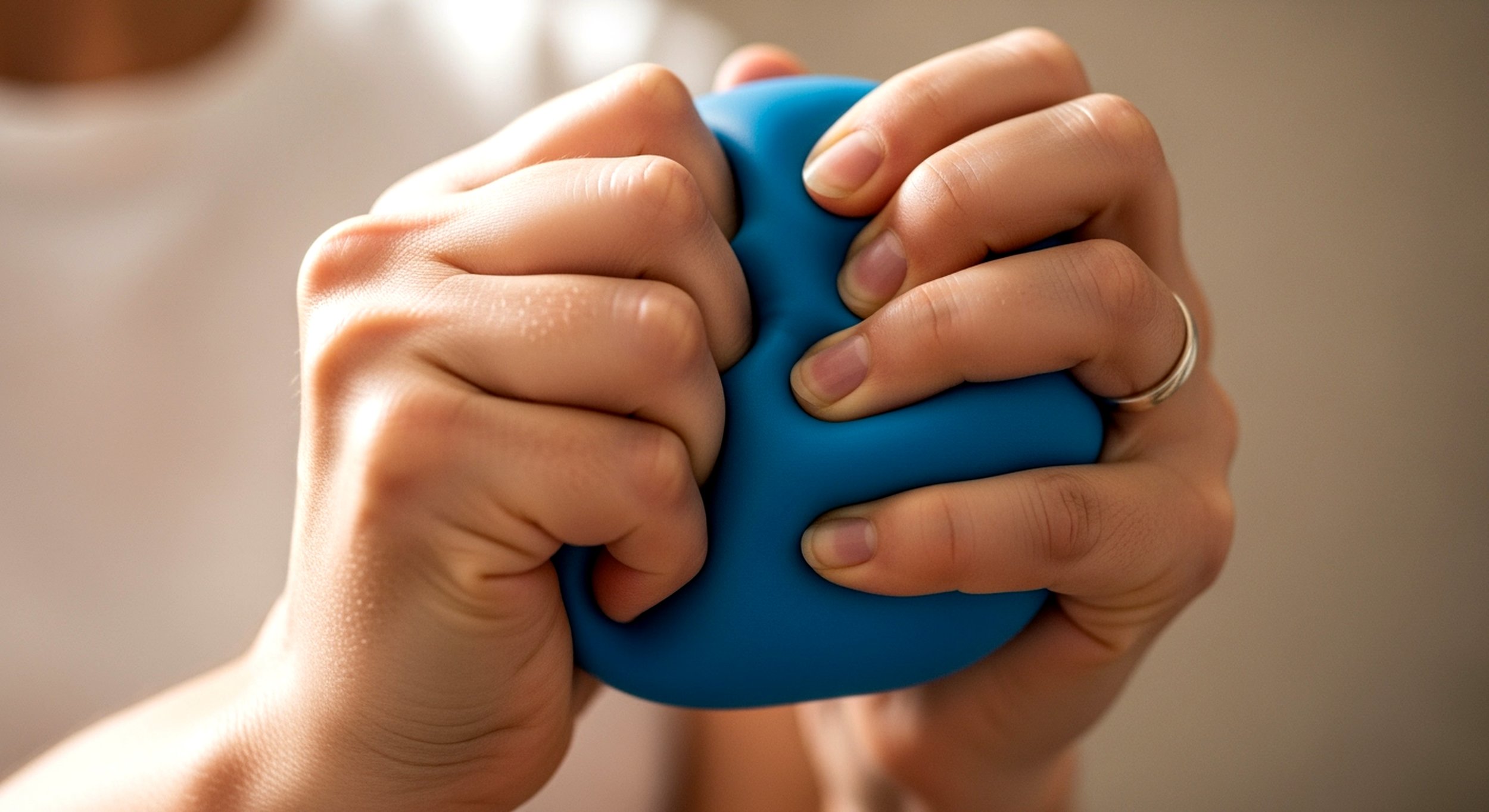
two hands squeezing a bright blue stress ball
First, a word about coping skills in general. What works for one person may not work for you, and that’s okay! I encourage you to listen to yourself, stay curious, and honor your needs. Does it ever work when someone tells an upset person to calm down? Not really, because our nervous systems don’t work like that! We can’t force or command our emotions. It tends to work more in our favor when we invite rather than scold.
Another thing to keep in mind with coping skills is that every tool might not be right for the job at hand. If you need to hang a picture, the best tools are probably going to be a hammer and a level, not a sledgehammer or saw. The same concept is true for the tools we use to cope with big feelings. With that in mind, let’s explore PMR so you can see if it’s right for you.
Step one
As you begin to learn a new coping skill, it’s important to practice it when you’re feeling more regulated than not. We’re trying to build confidence and mastery now, when you’re feeling okay, so when you are feeling very not okay, this tool is muscle memory for you.
Settle into a cozy spot like your favorite chair, your bed, or maybe in the grass outside. Seated is best, but if you need to stand or lay down, you can do so. Take some time to get comfortable, and spend a couple minutes breathing. You’re not trying to change your breathing right now- you’re just noticing what it’s doing and in that noticing you are getting more in touch with how your body and mind are feeling.
Step two
Now we will begin going through the body, intentionally creating tension and releasing it. Some people find they need to skip over certain body parts, whether that’s an area of physical pain or discomfort, or an area that triggers or causes dysphoria. Do what you need to do to take care of yourself. Some people like to repeat certain areas, or only use one or two areas. Make this tool work for you. The basic pattern throughout will be to create and hold tension for 3 counts, and release and notice. You can change the number of counts, just try to make the relaxation part at least as long as the tension part, or longer.
Let’s start by noticing your feet. Squeeze your feet by curling the toes in, pressing your feet into the ground, or imagining digging your toes into the sand on a beach. Hold for 3 counts (don’t forget to breathe!), then release. Take a deep breath and notice what it feels like to relax your feet. You may choose to breathe by inhaling through the nose and forcefully exhaling through the mouth (like a big “ha” sound), or inhaling and exhaling slowly and evenly through the nose. There’s no wrong way to do this, just make sure you are breathing and noticing what it feels like when you let go of the tension.
Step three
Now that you’ve got the hang of it, let’s make our way through the rest of the body. Notice your legs, whether it’s your lower or upper legs, or the whole leg. Imagine your legs are tree trunks, and you have to make them strong enough that the wind doesn’t knock them down. You can also think of flexing or squeezing your leg muscles. Hold for 3 counts, tensing as tightly as you can, then release and take a deep breath. Notice how that feels.
Move up to your belly, and squeeze as hard as you can, imagining you are pulling your belly button toward your spine, zipping up some tight jeans, or trying to squeeze through a door that won’t open all the way. Hold for 3 counts, then release and take a deep breath. Notice how that feels.
Let’s shift over to your hands. Ball up your hands into tight fists and squeeze, or press them down as hard as you can on the tops of your legs or your seat. You can also imagine you are squeezing lemons and trying to get all the lemon juice out. Hold for 3 counts, then release and take a deep breath. Notice how that feels.
Moving to your upper back and shoulders, tense your muscles tightly, raising your shoulders in a shrug and holding them there, pulling your arms closer to your body, or tightly wrapping your arms around your chest. Hold for 3 counts, then release and take a deep breath. Notice how that feels.
Finally, let’s move to your face and jaw. Scrunch up your nose, clench your teeth, and squeeze your eyelids shut. You can also imagine a butterfly has landed on your nose, and you are trying to wriggle it off. Hold for 3 counts, then release and take a deep breath. Notice how that feels.
Now, let’s do everything all at once. Squeeze your toes and feet, legs, belly, hands, shoulders and upper back, and face. Squeeze as tightly as you can and hold for 3 counts. Now release and take a deep breath. Notice how that feels. Some people like to ‘shake it off’ after. Do what feels natural to you.
Want a free, portable version you can save to your phone or print out? Click the button below to start your download. A PDF file will open in a new window.
Putting it into practice
Start practicing this skill when you are feeling pretty regulated, so it’s easier to remember and put into practice when you’re having a hard time and really needing it. See if you can identify experiences in the past where this tool may have been helpful. Are there any anticipated situations in the future where this skill might be useful? You could even imagine yourself using this skill in those future scenarios. Once you’ve spent some time getting more acquainted with this skill, try using it when you’re in that hard moment with big feelings.
Sometimes those hard moments happen when we are at work, in class, or out in public, and maybe it doesn’t make sense to have your fists balled up and your face scrunched up there. You can still use this, with some modifications. Maybe you only notice your feet pressing into the ground, your hands in your pockets making fists, your stomach clenched, and your legs as firm as tree trunks. Practice some of these variations, too. As you practice this skill, see if you can identify the types of situations where this is the right tool for the job for you. Does this tend to be effective when you are feeling angry? Overwhelmed? Anxious? Make note of that. Awareness helps us to manage our emotions in a way that best aligns with our values.